



In 2026, your approach to both applications and databases must be focused on practical and technical real-world operations and use cases rather than just hype. If not, you’re heading for trouble as threat actors are becoming more sophisticated and the threat landscape changes all the time, too.
Threats to Databases in 2026: What Are They?
Before we defend ourselves from anything, we have to understand what we’re defending against. These days, with StackOverflow spiralling down into the abyss, it’s logical to assume that AI-related threats would be at the top of the list and so, if we pull an UNO reverse card and ask ChatGPT what the threat landscape for databases would look like in 2026, we’d receive a couple of points to work on. According to the AI chatbot:
- Most successful database compromises in 2026 still start with the abuse of valid credentials: the most likely threat that ChatGPT refers to here is credential stuffing.
- Database compromises and application attacks in general will be heavily assisted by AI: ChatGPT thinks that attackers will use AI to assist their exploit development, identify high-value tables faster, generate realistic query patterns to evade detection by firewalls and other appliances, and tune their methods to stay under alert thresholds if firewalls cannot be evaded. In other words, attackers will dramatically increase their efficiency by using AI to automate tasks that would be done manually.
- Database and authentication misconfigurations will remain the low-hanging fruit for years to come: according to AI, misconfigured databases and related configurations have been widely exploited prior to 2026 and this threat is likely to continue into the future.
- Supply chain and dependency risks are growing: since databases rarely run alone, attackers are more likely to turn to their “assistants” (like database proxies such as ProxySQL), insecure monitoring and backup agents, or even third-party SaaS appliances facilitating database access.
- Data exfiltration will be more subtle and there will be less “in-your-face” threats like website defacements: according to the chatbot, attackers in 2026 prefer small but frequent queries that attack a specific endpoint, selective extraction of specific columns within a database, and blending exfiltration operations into normal workloads. Website defacements will likely still be a thing but, unless it’s a state-sponsored operation, they’re less and less prevalent.
- Compliance pressure is increasing the blast radius: according to AI, regulations haven’t reduced breaches, but they have dramatically increased their impact.
In short, chatbots think that the threat landscape in 2026 includes credential stuffing, AI-assisted operations (don’t mistake assistance with AI hacking into your database on its own), authentication misconfiguration threats, and threats related to dependency risks. With data exfiltration growing, breaches becoming harder to detect, and regulatory obligations raising the stakes, our databases and applications say that it’s critical to take the following actions.
Protecting Against Credential Stuffing
Remember the #1 threat on the list? Not SQL injection. Not Cross-site Scripting (XSS), Cross-Site Request Forgery (CSRF), not even AI taking over the world. The worst threat to your databases and the data within, according to ChatGPT, is the abuse of valid credentials, or in other words, credential stuffing. Credential stuffing occurs when a malicious party obtains a set of valid credentials from a data breach and then “stuffs” those credentials into a login form belonging to an unrelated website. Oversimplified, everything looks like this:
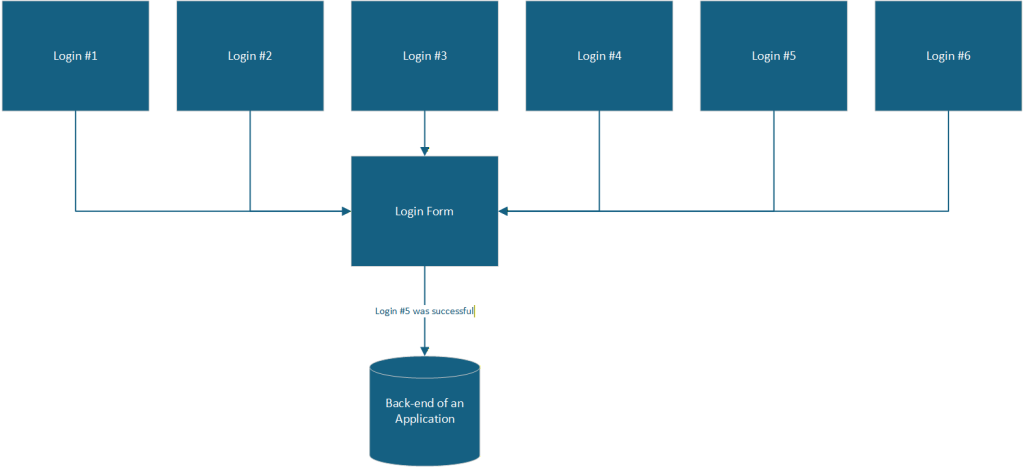
“A list of valid credentials”, nine out of ten times, relates to leaked data from a data breach. Now multiply these 6 logins by a couple billion times (there are thousands of data breaches in the wild and that’s not even counting those in private possession of hackers) and, unless all of your users are using a password manager with passwords consisting of 30 or more characters (be honest: we all know that’s not the case), you can be damn sure that a couple of them will work and unlock the doors towards the back-end of your application. The user table of your database gets taken and the cycle repeats.
Thankfully, though, protecting your database and application against credential stuffing is not that hard: all you have to do is apply brute-force prevention measures on all of your login forms. That may be as simple as allowing no more than X requests by the same user in the span of Y seconds, or adding 2FA where applicable.
Granted, you cannot do that through your database alone as you will need some back-end code working in conjunction with your database, but it really is as simple as adding a couple of columns in the users table, then acting on them with a back-end programming language to check if they have values and what they are:
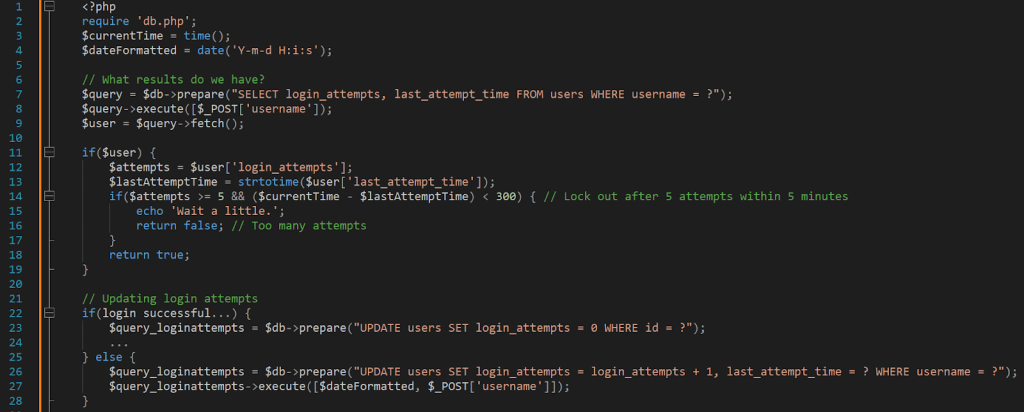
Such protection measures are an effective weapon against credential stuffing because it eliminates the core concept of the attack: a rapid “spam” of requests is no longer effective due to a “cooldown” from the outside (users cannot log in more than once in a certain amount of seconds) and thus, attempting billions of requests at once is no longer feasible – unless you want to wait a month or two, that is.
Protect your data. Demonstrate compliance.
Blocking AI-Assisted Threats to Databases
Now, while countering credential stuffing is quite straightforward, countering AI-assisted threats may not be. You see, the culprit here is a nefarious party using AI to enhance his/her capabilities, and that means AI will be used to speed something up – instead of, for example, an attacker taking Sentry MBA and wreaking havoc on your login form to hammer your database. As there’s no definite attack vector, it’s hard to protect against them.
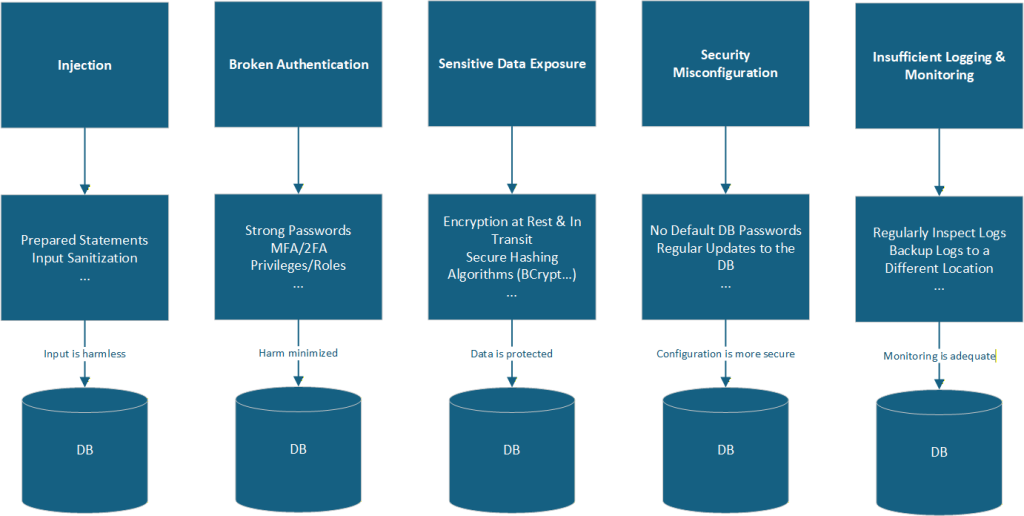
At the same time, AI-assisted threats are just that: assisted threats. This means an attacker will largely use his own knowledge on your application and then turn to AI if things turn sour. In other words, all you need to do here is to follow security guidelines applicable to your use case, and you should be fine. Most of those security guidelines will relate to the OWASP Top 10 and threats around it. For your database, that means the following:
The OWASP Top 10: What Are They?
You need to increase your knowledge around the threats outlined in the OWASP Top 10 because, put simply, these are the worst security threats – a nightmare for the security community.
It may not be updated often (the previous version of OWASP was released in 2021, and 2017 prior to that), but knowing your way around the top 10 is a great way to make your application resilient to the many threats that may cause harm in the future – especially when, at its core, the listing doesn’t change all that much.
The last 3 listings included broken access control and security misconfiguration as well as injection and insecure design, indicating that approximately a quarter of issues are likely to stay there for multiple years.
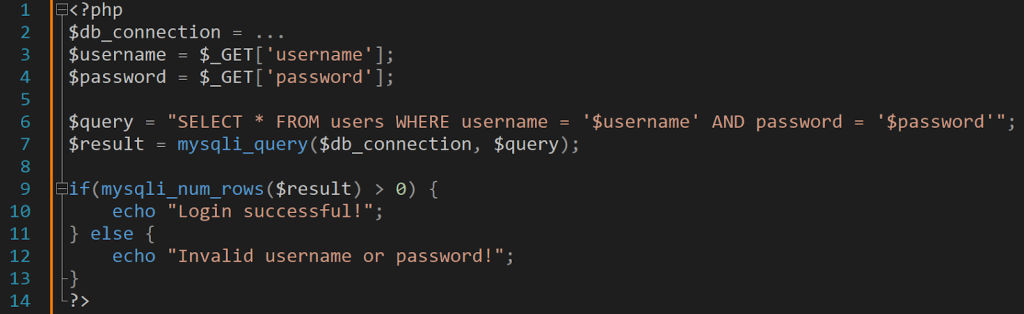
With that in mind, crafting a strategy on how to make your application and database resilient to the threats outlined in the OWASP Top 10 is crucial. It’s not that hard to do, either: for starters, implementing a Web Application Firewall (WAF) and following the advice in the graph above will do just fine, assuming your code doesn’t look like this:
Improving Measures Related to Monitoring and Logging
Monitoring and logging is a part of every application and database. At the same time, when was the last time you took a look at the logs? I don’t mean this:

I mean logs like the error.log in MySQL / MariaDB, the general SQL query log at general.log, the access logs at access.log, and so on. When was the last time you inspected them? It isn’t that hard to do: for example, grep “2026-01-05” access.log, will display all entries related to January 5th, 2026.
Inspect them one by one, perhaps download them and inspect them using Notepad++ or other software, and look for anomalies: are there any? Do this every once in a while and consider exporting anomalies to a database or another server; logs will be wiped after a compromise, so inspecting them afterwards won’t be of much use. You’ll be surprised how many records you’ll acquire.
Whether you like or not, logging things in your database may even be required to stay compliant with regulations like HIPAA, GDPR and CCPA. There’s no need to panic – you can avoid storing sensitive data (or wipe it once in an interval if you must store it) – but keeping an eye on log files once a week or so won’t hurt.
Staying Compliant With the Law & Regulations
Last but not least, it’s important that you stay in line with the applicable regulations, too. It’s impossible to discuss these all in a couple of paragraphs, but do your research, ask AI (and cross-check its responses: you’d be surprised how many sources are made up), and ensure you stay compliant. Non-compliance will be costly.
Surprisingly, there’s quite a bit you can do on the database front to facilitate this:
- Use whitelist-based input validation before inserting data into your database.
- Hash or encrypt sensitive data (look into BCrypt or Blowfish for storing passwords. PBKDF2 works too).
- Reduce the collection of data where possible (only collect data that’s strictly necessary).
- Implement strict user roles and permissions. This will help with data access, ensuring that sensitive data is only available to authorized individuals. Additionally, take a look at your logs more than once a year.
- Utilize data anonymization measures. Whenever possible, anonymize or pseudonymize data to protect personal data from being exposed.
- Set clear data retention policies. Set clear policies about how long data will be retained and when it should be deleted or anonymized.
- Have a plan for a data breach. Having a clear, documented plan in place for responding to a data breach is essential: the last thing you want here is to be caught off guard.
Alongside regulations there are laws, too. Some of you may not read too much into this, but for some use cases the law will require a lot of your attention. Imagine you’re dealing with stolen data and running a data breach search engine behind your database; no matter what DBMS you elect to use, you may wonder if you can show sensitive information pertaining to stolen data to anyone who searches for it? Perhaps. Maybe not. Depending on your jurisdiction, laws will always come down to:
- Where you’re located (what laws will be applicable to you).
- Who you’re operating from (operating a website or an application under a company isn’t the same as operating as an individual).
- What exactly you’re doing.
As much as the law isn’t a game, you can do the same things in different countries and your actions can be treated as being in line with or breaking the law. Study the law and know your rights – for example, GDPR states that everyone can request their data to be deleted.
Summary & Next Steps
Securing your databases and the data within during 2026 may not be the simplest of tasks. At the same time, it’s far from rocket science. Evaluate the landscape behind the threats to your data and database, and know how to respond to database and application-related security issues like injection, broken authentication, sensitive data exposure, insufficient logging, and monitoring. Then, you should be good to go!
FAQs: Securing Your Databases in 2026
1. What are the threats to my database in 2026?
Threats to your database in 2026 include credential stuffing, injection attacks, AI-assisted threats, as well as those outlined in the OWASP Top 10.
2. How do I protect my database from these threats in 2026?
Employ simple security measures to protect your database in 2026: only assign necessary privileges and roles to the users in your database, utilize input validation on the side of your application, don’t use default passwords in your application or database, regularly inspect the logs applicable to your application and database, and use strong passwords where applicable.
3. Is AI a threat to my database in 2026?
AI is a threat to your database in 2026, though not directly. AI chatbots like ChatGPT are capable of making an attacker’s operations faster, but only if they have previous knowledge of their target (your application/database.) Look into the OWASP Top 10 for a start, combine the protection measures with roles and privileges and roles inside your database, and you should be fine.
Additionally, keep expanding your knowledge of security & compliance best practices on sites like Simple Talk, watch webinars, attend events and conferences, and don’t forget physical books too.
What are the database risks you can’t afford to ignore?
This document contains proprietary information and is protected by copyright law.
Copyright © 2026 Red Gate Software Limited. All rights reserved





Load comments